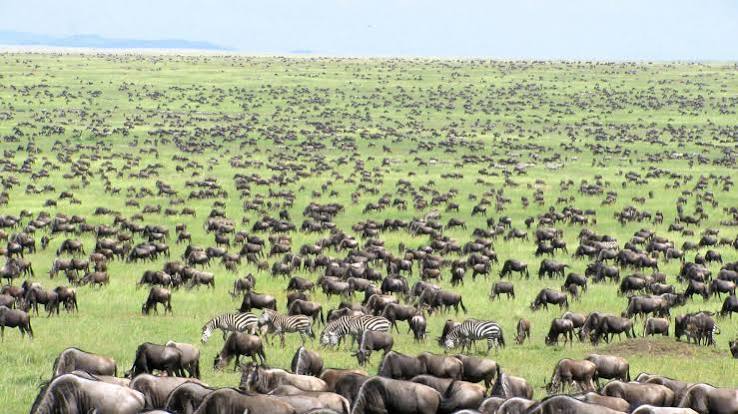
The site of endless herds of animals has been a dream of mine. I imagined thousands of wildebeests, impala, gazelle, elephants, giraffe making their way across the African veldt in their search for food and water and the predators trailing behind, waiting for their opportunity to feed themselves and their young. So, in September, I went to East Africa in search of that great migration.
But I didn’t see it.
The “hoards” had passed two weeks earlier. There were remnants of herds left grazing. The land was brown and barren save a few Acacia trees popping up on the horizon. The water was either too much or scarce, depending upon the source. Too much from Kilimanjaro whose snowfields were now nearly gone. Too little from persistent drought and climate change.
I left East Africa with deep sadness at what is being lost. I know those animals will not be able to adjust quickly enough to the changing climate. In my mind I can imagine the scene from, say, 200 years ago when the sight of wildlife was overwhelming. But the continent was being carved by colonial powers; animals hunted indiscriminatingly simply because no one could imagine they would become extinct.
I suppose it is the lack of imagination that angers me. But if I forgive 18th century sins, what about our own time. How have we let this happen? How have we permitted the glorious selection of animal life to suffer so on this planet? How can we develop the imagination to maintain what’s left so we can live in peace with them. How do we act less as invaders and more as companions? If imagination fails us, why doesn’t science offer a lifeline? Recent studies of the Maasi Mara and Serengeti show a dramatic reduction in population: from the once accepted number of 1+ million wildebeests to now a guestimate of 530,000. But both imagination and science have saved the Mountain Gorilla and other favored species from extinction.
Imagination takes us a few steps forward; the lack of it sends us reeling backwards.
Having failed to see the great herds in East Africa, I looked forward to the annual Deer Rut at the local wildlife refuge, Rocky Mountain Arsenal National Wildlife Refuge. That’s our own, wonderful refuge literally 10 minutes from our apartment.
A little background. The Arsenal once housed chemical weapon production. It closed and became an EPA Cleanup Site. Then, people planted native grasses, plants and flowers. Bison were introduced. The Black Footed Ferret, nearly extinct, was released to dine on the ample supply of prairie dogs. Eagles nested. Hawks returned. The mule deer, native to the area, remained. Coyotes, badgers, raccoons, skunk all found homes at the 17,000-acre refuge.
I began volunteering there early in 2026. I’m posted at the Visitor Center welcome desk. I answer questions and direct people to the wildlife drive which takes them through the peaceable habitat for some 300 bison and about 280 bird species. Every few weeks or so, I drive through. Sometimes I only spot one or two bison. Other times, a good portion of the herd arranges itself across the road. I thrive in those moments. If I put my hands around my eyes, I can pretend that I’m looking at an entire prairie full of bison. Not just a couple of hundred, but millions upon millions.
Each year the staff checks the health of the bison herd, count the Ferrets, Mule Deer and White-Tail Deer.
The other day, Ray, a long-time volunteer, offered tours of the Deer Rut. I signed up and met him and 8 others for the three-hour drive. This tour is particularly wonderful as it travels roads and trails never seen by the public. The Refuge has one road that loops within the acreage. The remainder is off-limits. The first thing Ray mentioned was that he hadn’t seen many deer. He told us that just two years ago, hundreds of deer were going crazy with the rut. He would just park the van and watch as stags chased does, fought with each other, protected their newly won charges.
But now, the population had dwindled from 500 to less than 100. Why?
Coyte predation had increased because a new development had been built north of the Refuge. Now the Refuge was surrounded by development. The coyote moved onto the Refuge in significant numbers.
Drought. Our ability to sustain these deer populations was diminished. Colorado is dry. We get maybe 15 inches of rain annually. But the indigenous plants and animals adapted and do fine, if drought doesn’t sit around for any length of time. The current Denver area drought has persisted for the past 13 months. Animals that can move during drought do so. But those in a closed system like the Refuge, can’t.
The Refuge will figure out ways to manage the situation.
But what they can’t fix is the overall loss of species world-wide. And it’s heartbreaking to imagine a world without the glorious, graceful, elegant, powerful, gigantic, diminutive, striped, spotted, plain, camouflaged, four legged, winged, finned, six legged, eight legged, crawly, airborne, creatures that inhabited this planet long before we took our first upright steps.


Leave a Reply