For forty-eight years, we lived on a secluded property. A thirty-foot-tall brick wall created the facade of the house. There were no windows so we couldn’t watch the events on the street or sidewalk. The wall was framed by three spectacular Red Bud trees. A walkway paralleled by Oregon Grape and covered by a pergola led to the front courtyard. It formed a rather elegant entry to a house that would disabuse anyone from believing the interior would retain the same flavor.
People would come in, walk up the stairs and be greeted by the welcoming sight of large windows that opened onto the gardens. I loved the looks on people’s faces. And, then came the comments which I grew accustomed to hearing over all those years: “No one would know this is here! This is gorgeous. Can I walk out there?” The gardens were lush. Large tees, a sculpture garden, perineal gardens, green house, chicken coop, and ultimately a hidden woodlands garden waited for company. The gardens offered greater privacy than the large brick wall. And, yes, every guest walked out to the terrace, down the stairs and meandered through.
So, we left the home and gardens we loved and moved to a very urban, noisy, active, and rather chaotic environment.
We selected a first-floor apartment that faced Syracuse Street. We liked it for one reason: it had a front door as well as one that led to a hallway. We didn’t want to have to walk down a hallway, get into an elevator, walk down another hallway to an exit to take Monkey out for a piddle, poop, sniff and a walk. Four times a day. Nope.
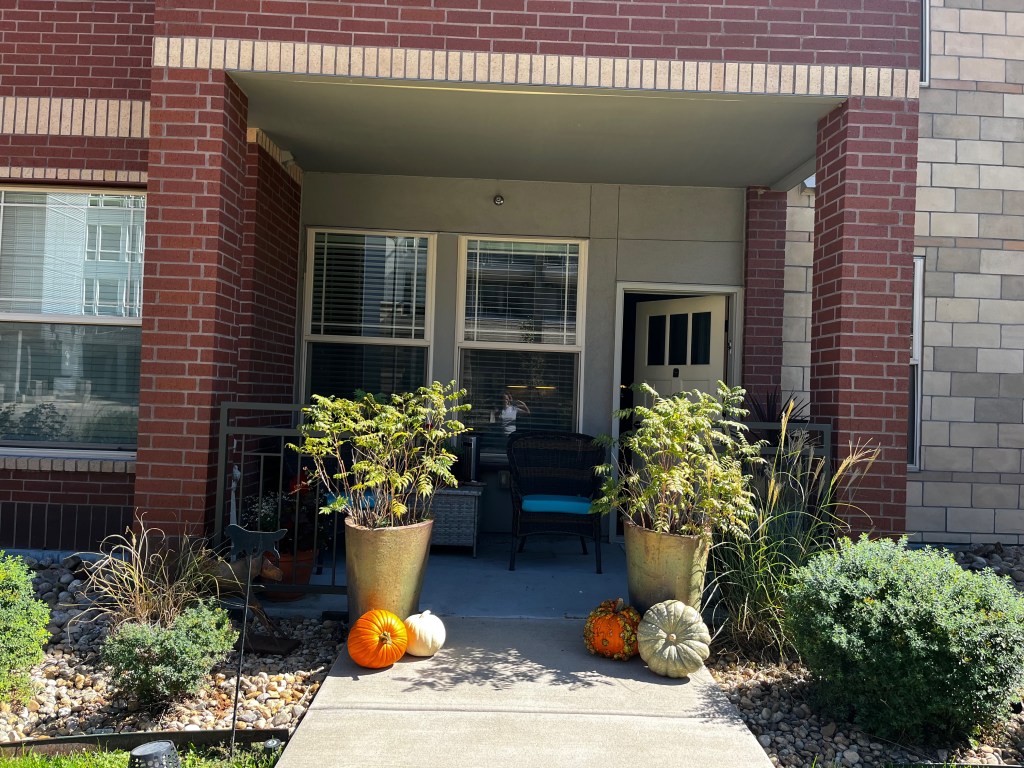
Our apartment has a front porch and a patio, both facing Syracuse Street. There are apartments and condos around us. This is not a quiet back street. It’s noisy. Young men with no sense race from the stop sign to the light. It’s literally one block. They can’t seem to resist the challenge.
But then there is the life on the sidewalk in front of our apartment. Old people, young people, young families. People walking to the Farmers Market on Sundays. People strolling to the Saturday evening concerts held on the South Green. Folks just walking by. And dogs.
All sorts. Small, large, giant. Monkey stares at them, maybe gives a little tail wag, barks, follows them as they pass, just to be sure they’re gone. Humph, she thinks, they won’t be back now that I’ve let them know this front porch is mine. This part of the grass is mine. I’ve marked it. I’ve claimed it. This part of the sidewalk is, most definitely, mine!
Multiple times a day, I walk outside for a Monkey job. Anything can happen. The other day, the woman with the gorgeous Newf, Allman, walked by. I should say, she was dragged by. Allman hasn’t quite learned manners yet, but that sweet boy gives me a look only another Newfie person could understand and I walk over and as his person strains to hold him, I kiss him on the head and get a Newfie lick on my cheek. I spend some time just petting him. There is nothing quite as miraculous as feeling the musculature of a giant breed dog. They resonant health and power, yet their gentle demeanor belies their strength.
The numbers of small creatures, mostly grifter mixes rescued from wherever, walk by, tails held high with pride knowing their owners had the good taste and sense to adopt them.
Jeff, an Irish Wolfhound, is too fabulously wonderful to even describe. His 180-pound stature begged me to walk over for a pet and a kiss. His owner also struggles to save herself from being dragged down the sidewalk. Oh, I asked. Who suggested you use a gentle leader (it’s a leash that wraps around the nose for greater control of the dog)? The trainer, she says. Umm, I say, Wolfhounds are hounds. They lead with their noses. Find a good harness instead.
I think she appreciated the advice. I’m looking forward to the next passing-by to confirm my theory.
The Rabbi from the Chabad and his family walk by quite often. Yesterday was the second day of Rosh Hashana and they were leaving the Chabad on their way home. He tells me I missed the Tashlich. This is a ritual on the first day of Rosh Hashana where we throw our sins into the water and the Shofar is blown as we pray. As it happened, it was raining rather heavily but we went. Didn’t see them. We parked, waited some more. No Jews showed up.
No. He said. We were there. His wife agreed. So did the Cantor and his wife who had come from Israel. They had all been there.
But, he said, I have the Shofar right here. Would you like me to blow it?
The Shofar is made from a ram’s horn. Its description stems from the Torah. The sound it makes is a bit bone rattling but beautiful in a way that stirs ancient longings.
Yes, I said. Please. Absolutely.
So, he did.
We stood there, the Rabbi, his wife, the cantor, his wife, a gaggle of children, Monkey and me while the Shofar sounded. And while it was blown, the Rabbi had me read a Hebrew prayer. Since I can’t read Hebrew, he said each word as I repeated it. Here’s the English translation.
Who is a God like You, pardoning iniquity and forgiving transgression to the residue of his heritage. He retains not His anger forever, because He delights in kindness. He will again have mercy on us. He will suppress our iniquities; and You will cast (tashlich) our sins into the depths of the sea.
The Rabbi said to me, “Hashem granted your wish. You wanted me to blow the Shofar on your front porch, and here we are.” I had to agree. There must have been some divine intervention.
As we finished chatting, a woman came up with her two children. They wanted to meet Monkey. I said goodbye to the Rabbi and his group and began talking with the woman and her kids. How old is Monkey the little girl asked. Seventeen, I said. Wow.
That’s what all the passerby’s say. Wow. Seventeen. Really old.
Of course, all this reminds me of something else in my life which will be the point of this blog.
Many years ago, we took Alba back to Nicaragua. The Revolution had been successful, and Somoza ousted and executed. The country was raw and travel was precarious but we were fortunate to have two Sandinista friends of Alba’s mother guide us so we avoided landmines and fall in love with backroad villages. We stayed at her mother’s home in Leon which is a colonial city. That means blocks are extremely long and the facades sit on narrow walkways. The homes give little evidence of what lies behind. Doors usually open into a large living/dining/kitchen space which then leads to courtyards or gardens. Each house has two front doors. I don’t know why but they do. Alba’s mom, Amalia, would sit in a rocking chair at the open door and chat with people as they walked by. It was an incredible procession of friends. Children, old people, dogs, infants being held, being toted would pass by. Regardless of what had been suffered, the earthquakes, revolution, counter-revolution, hurricanes, exploding volcanos or poverty; life was vibrant and on display through the endless parade of people passing by Amalia’s front porch. When Amalia stayed with Alba in Milwaukee, she was always lonely. Alba’s home was like ours: quiet and private. Her home backed to the Milwaukee River and sat on a half-acre with an expansive lawn in front. But for Amalia, it was simply lonely. No one passed by. If she wanted to touch some life, she had to drive somewhere to find it.
Now, as I sit on my own front porch, I remember with great fondness and love, the times spent with Amalia on hers.
If I want to touch some life, I only need to open the door and walk through it.
 Air.
Air. 
Leave a comment