
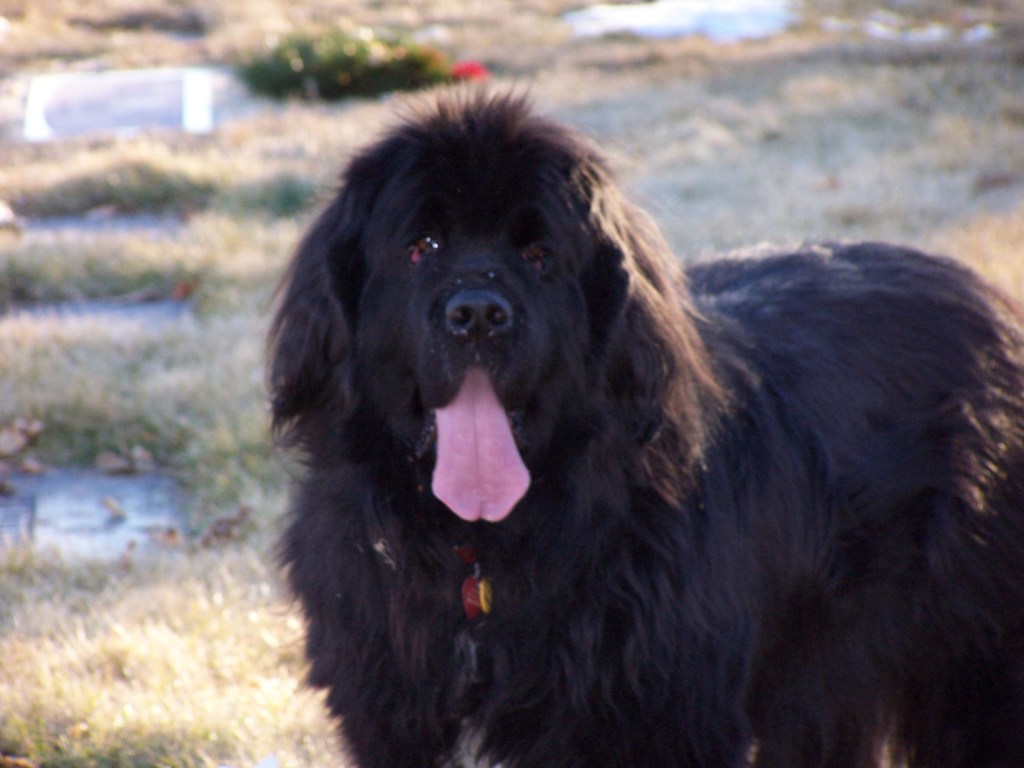
I volunteer for National Newfoundland Rescue. This group rescues, fosters, medically treats and adopts Newfs or Newf mixes. My absolute adoration of this breed is well known to my friends and family. GB and I loved 7 Newfs over a period of 40 years. Other, equally wonderful dogs, cats, chickens, and one naughty little conure named Paulina, were interspersed and part of our odd family.
I digress.I interview applicants who want to adopt or foster the dogs.
Today I received my first foster application. It’s similar to adoption but a big difference is that the foster learns about the dog, the personality, the strong points, the problems before adoption can happen.
GB and I have adopted more than our fair share of dogs with significant issues. They tested our patience, tolerance and ability to understand their needs. There was Shiney, a Lab-mix, who had separation anxiety to the point that she chewed our newly purchased windows in the dining room and office area. Her fear of thunder or fireworks took us down the path of hiring an animal behaviorist (did no good), a psychic (did no good), drugs (did no good) and finally making sure she was with us when thunderstorms hit and not leaving the house two weeks before and after July 4. I was working at the Jewish Community Center during part of our time with Shiney and each day, I hired a dog walker to take her and Ghengis for a little walk and then drive them to my office. Now Colorado summer storms happen after 3 pm. But one day, a storm arrived in the morning and Shiney tried to escape the yard. She impaled herself on our front rod-iron fence. A neighbor heard her yowls and rescued her. Another neighbor called GB who immediately left his clinic and took her to the vet. I arrived just before she went into surgery to repair her horrific wound. Nearly $10,000 later, she survived and lived another 8 years.
There was Winter. A beautiful Newf who had been used as a brood bitch. Her last litter was mismated (meaning she bred to a different breed). As a result, she was spayed. That’s when she came to us, unsocialized, terrified and in mourning at the loss of her litter which was, I believe, sent to a shelter or destroyed. Winter denied any contact with us. She refused to eat from a bowl. She refused to come into the house. We fed her by placing food throughout the garden so she could forage. Like a bear. We rarely saw her. We began placing the food so it would lead into the dog door and into the house. She took the bait but if she saw us, she ran back to the garden. Slowly, she began to stay in the house for longer periods of time. Many months later, she sat next to me. I patted her head, and she leaned ever so slightly into me. After that, she allowed us to cuddle, hug and just love her. We could take her on off-leash walks. She’d roll over for tummy rubs. She had become a dog with a family. But, whenever anyone came over, she ran outside and lay down on what we dubbed “Winter Hill”. When the intruder left, she’d come back in. A year after we rescued her, we purchased Doc, a gorgeous purebred Newf from a local breeder we trusted. Winter fell in love with Doc. She had a puppy again and her maternal instincts took over. They were bonded until Winter died years later.
So, what is this story about? Capacity. What does it take for us to learn our own capacity for love, forgiveness, struggle. How do we learn to adapt ourselves to meet the needs of those animals who are struggling? Or people.
In many ways, it’s easier for me to cope with animal challenges than human. My professional career dealt with humans. My heart career goes to animals.
Until now that I need to add capacity for human struggles to my wheelhouse.
I find that I need to build capacity to deal with GB. Despite his successful surgery, he continues to struggle with cognitive issues. They arrive through different vehicles. He doesn’t follow the characters on a binge series. He thinks he starts the dishwasher but doesn’t. He has little concept of time. I’ll let him know we need to be somewhere at, say, 6 PM and by 5:00 he hasn’t made any effort to shower or change his clothes. He doesn’t hear clearly statements I’ve made. Some of that is because he hasn’t put his hearing aids in. The rest might just be the clouds that have remained in his brain. The damage done by the hydrocephalus isn’t easily undone.
But I’m impatient. I keep thinking he’s all there when he isn’t. So, I pick at him. Criticize him. It hurts his feelings and then I realize what an asshole I can be.
GB lives very much in the moment. He’s sort of like a Zen-man.
I’m not an in-the-moment type. I plan. Organize. Figure out how each hour of the day feeds into my time. I see time as a continuum, not in chunks of the present. I look at days, weeks, months, years in terms of what needs to happen to make the next thing work. I take out the frozen chicken in the morning because I know what I’ll cook for dinner. He decides he’s hungry for lunch not around noon, but at 4 pm. Then he eats a whole meal and isn’t hungry for dinner which is usually around 7.
My days are filled with blogging, reading, news-watching until I’m too depressed to watch any more, working on development plans, fundraising issues, interviewing Newf applicant families, analyzing grants for the Denver Foundation, cleaning up the apartment, making dinner, grocery shopping, taking Monkey for walks, joining the Yappy Club at the apartment and, just recently, the group that plans monthly events. It’s the same life I’ve always had. Full of domestic and professional (now volunteer) chores. The only thing missing is the half-acre garden that finally exhausted me.
GB’s days are different. He’s at a loss for what to do. He joined the poker group at the apartment (which he loves). He wants to volunteer at the local library, located around the corner from our apartment. He’s applied, but the process is painfully slow. He goes back to the house on Wednesdays to put right the sprinklers the mowers have dislodged. He needs things to do. He needed them before we moved, but I guess he didn’t think much about it because there was always the illusion of getting things done at the house.
So, I need to build my capacity for GB issues. It’s hard. I’m not a particularly outwardly empathetic person. And I’m a hot reactor so I explode first, think next, calm down last. The explosion, thought, and calm can take place in less than a minute, but the explosion is the part that hurts GB. It’s hard to take back snarky comments, eyerolls, or just an ugly face.
And, I have a fundamental question about him. It might just be men, but I don’t want to condemn the entire gender. How does he think meals get arranged and cooked? How does he think plumbers are called. Things are fixed. How does he think the house remained clean despite dog and cat hair being deposited over 48 years. I the kitchen cleaned by magic? Now, if I’ve mentioned he could do one of these chores, he’s mostly been agreeable. But he generally looks at me like he can’t imagine whatever it is needs doing. This basic conflict might affect my ability to build capacity.
If GB were a struggling dog, what would I do? I guess I need to apply the lessons taught to me by Winter and Shiney so many years ago.
 Air.
Air. 
Leave a comment