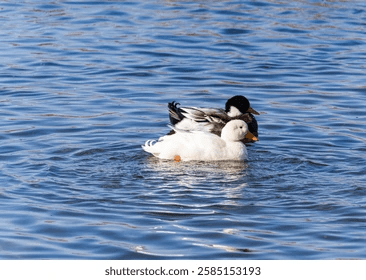
For some reason, I received a call from the Colorado Humane Society about ducks frozen on a pond. Apparently, they needed homes after the rescue. Of course, GB and I ran right over to adopt them. At the time, we had our original two dogs, Cruiser R Roozer and Barney, plus a number of cats. The ducks would fit well but we didn’t have a pond. And, it was the middle of winter, which is why the ducks were apparently “frozen to the pond”. In thinking back, I can’t imagine how ducks would be frozen to a pond and if they were, how anyone would get them out without chainsawing the frozen ice around the ducks, hauling them to a safe place, letting them defrost and finally, putting them up for adoption.
Nevertheless, we adopted them without much question or thought. We also knew nothing about ducks other than they like water and they eat duck food. We named them Maynard and Elwood. Maynard was a white domestic duck and Elwood, black and white.
Because it was cold and we didn’t want to traumatize them, we had them live in the upstairs bathroom/tub. They seemed rather content with the lukewarm bath water, We put some small stairs on either side of the tub so they could go in and out at their pleasure.
Spring arrived and it was time to get serious about the ducks and their habitat.
We needed to construct a pond.
Now, the garden was accessible only through two standard size gates. That meant useful equipment couldn’t be used to dig the pond.
It had to be done by hand.
We hired a crew of about six men with shovels. They dug all day and when they were finished, we had a hole in the southwest corner of the garden that was 23 feet long and 4 feet deep with a shallow entry. We lined it with a swimming pool liner and began filling.
Once completed, the ducks were ecstatic.
Thinking their environment wasn’t quite perfect, we added expensive Koi who were promptly eaten by raccoons. Then we purchased feeder fish. They thrived, reproduced, overwintered in the deep end of the pond and kept the ducks entertained. We added pond plants. Lily pads and water irises began growing. Ducks were thrilled.
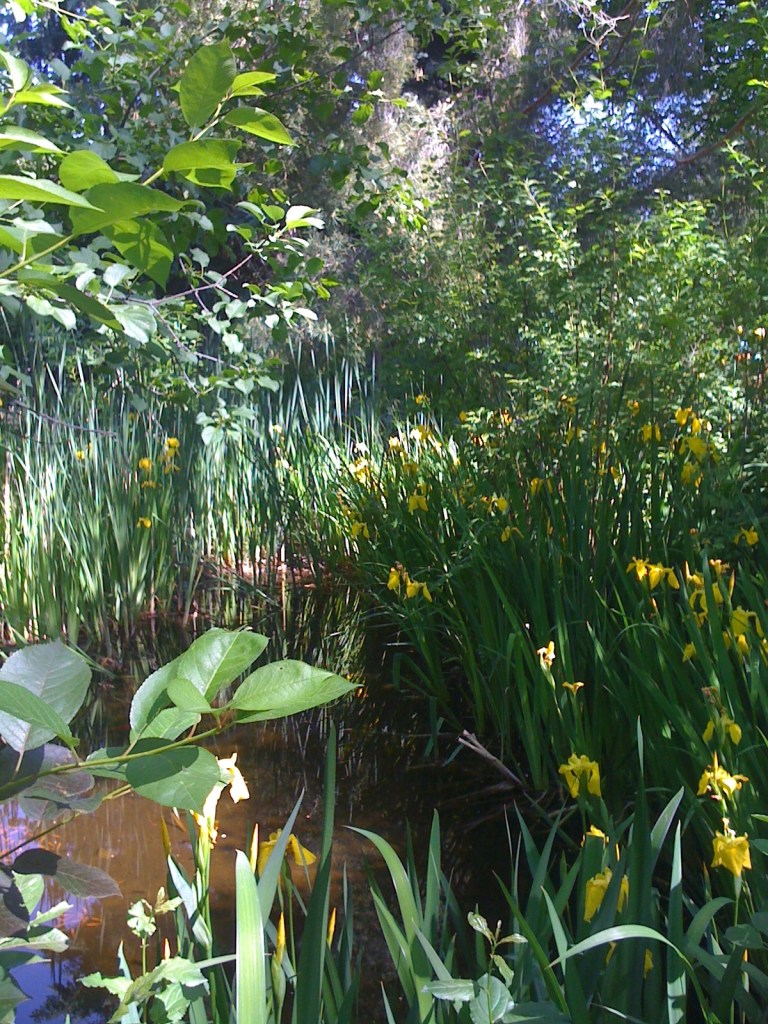
And, because of the water source, more critters began to visit the garden. We had herons and a vulture or two. Raccoons, skunk, fox, forty million squirrels, garden snakes, and a coyote or two visited or sometimes just stayed in residence. The pond created its own wetlands in the shallow areas and reeds began to emerge. Each autumn, we’d harvest the reeds for their furry, brown pods. Then, I’d trim the reeds and put them into a tall silver vase that was a trophy won by my grandfather, Louis, for trapshooting.
We affixed a hammock to the branches of our largest old cottonwood tree. Both of us spent hours lolling in the hammock, listening to the birds and the ducks, petting the dogs, watching the cats explore the ever expanding habitat that was created simply by digging a pond.
The ducks didn’t mind our encroachment on their pond. They didn’t even object when the dog breeds changed from mutt to Newfoundland.
But, there was a slight problem. The pond would need draining and cleaning. The ducks would refuse to leave during the process, moving themselves closer to the deep end. But, Newfoundland Dogs are bred for water rescue and when Max and Winnie, our first two Newfs, saw the ducks in shallow water, they instinctively rescued them.
During one of the rescues, blood was drawn. We hustled Maynard and Elwood to the vet, picked up antibiotics and brought them home to recuperate in the office behind the garage. Each day we administered pills by gently holding the neck, opening the beak and stuffing the pill down the throat. They objected but we won the battle.
Once returned to the pond, the Newfs saw no need for rescue.
But, the next cleaning arrived and once again, the Newfs rescued the ducks. The last rescue was difficult. Elwood was weakening and Maynard was doing his best to defend him by pretending to be dead. This drew the Newfs from Elwood and onto Maynard for a gigantic rescue. Max picked up Maynard and took him to the middle of the garden. Winnie stood guard over Elwood.
It had become clear that we couldn’t protect the ducks from the generous instincts of the Newfies. We discovered a duck rescuer living in Lakewood. She agreed to take our two boys, who at that point, were bonded to one another. They lived out their lives with other ducks, geese, chickens and ponds.
Ducks gone, the purpose of the pond changed. My sister-in-law, Jane, held a summer camp in our garden. Fifteen 3-5 year old children came weekdays. The Newfies protected them from falling into the pond. The children discovered all kinds of insects, critters, and plants. They dug snails out from the walls of the pond. They uncovered strange, wormy items under rocks. Each day, Jane set up the camp next to the pond and beneath the giant cottonwoods. The Newfs would spent the entire time with the children, letting them snuggle in their soft bellies. Sometimes, the children would play king of the mountain and pile on top of the dogs who, apparently, were the mountains. I’d wander out and see a pile of children on top of nothing but a wagging tail. On the 4th of July, the children decorated the dogs and created a parade down to the park. The dogs were festooned in patriotic garb and led by small children using only a pieces of string for leashes.
The pond became the center-point for the Southminster dog shows. Thirty-five dogs and 25 women would celebrate the love of canines each summer. This party was the brainstorm of my friend, Wendy Bergen. My mother was recruited as the judge and was immediately bribed with Scotch or simply threatened by dog owners anxious to win the grand prize which, by the way, was pretty much nothing. We opened the doors to the house, filled additional baby swim pools in hopes that not all the dogs would go into the pond and come out smelling of swill. Wet dogs ran freely up the stairs to the terrace, through the house, down the stairs to the front courtyard and around to the back again. This repeated endlessly throughout the day.
I suppose the best times were when our grandson, Eyad, visited. He’d spend hours at the pond, searching for whatever little boys seek. One year, he created a pulley system to transport our cat, Sophie, from the pond to the terrace. It never quite worked, but he was adamant that the design would eventually prove him an engineering genius. He utilized the assistance of Katarina, the little girl across the street. Once the two of them exhausted their skills on the pulley construction, they turned their attention to selling rocks they had found in the pond. They set up a stand in front of the house, complete with signage “Rocks for sale”. God bless the one person who stopped, looked, and purchased one rock.
But by 2020, the pond was leaking and the water usage made no sense in a climate as arid as ours.
So, we drained it, re-homed the remaining fish into a local public pond, and filled it with tons of dirt to create the Woodlands Garden.The core of the garden consists of shade ferns and flowers. A flagstone path meanders into and out of the garden. Two chairs sit waiting for us to soak up the peace. Native trees have grown to provide the necessary shade and coolness that is the hallmark of the area. Because on any given summer day, the Woodlands is at least 5 degrees cooler than the surrounding gardens.
While the pond is gone, the plants it attracted remain. The habitat still welcomes birds and critters. It remains the most secret corner of the garden.

Planting what was the pond.
 Air.
Air. 
Leave a comment